> For the complete documentation index, see [llms.txt](https://lite.guides.instadapp.io/llms.txt). Markdown versions of documentation pages are available by appending `.md` to page URLs; this page is available as [Markdown](https://lite.guides.instadapp.io/getting-started/vaults-features.md).
# Vaults Features
Information on Lite Vaults v2
Fluid Lite utilizes **stETH, wstETH** and **weETH** (tokenized staking deposits on Ethereum that earn daily staking rewards) as well as yield bearing stablecoins such as **sUSDe , syrupUSDC, syrupUSDT and sUSDai,** together with core stablecoins like **USDC**.
By using these assets as collateral in lending protocols, the vault borrows (ETH for the stETH vault and stablecoins for USD), swaps back instantly, and redeposits looping continuously to leverage and amplify the base yield.
## Tokenized Vault Deposits
All deposits into Fluid Lite ETH vaults are tokenized as **iETHv2**, while USDC deposits are tokenized as **fLiteUSD**.
These tokens represent your share in the vault and are redeemable for your original deposit plus accrued interest.
#### ERC-4626 Standard
Fluid Lite vaults utilize the ERC-4626 vault standard. Making the Lite vaults even easier to integrate and utilize across DApps. Looking to integrate Lite vaults? Reach out to us on [Discord](https://discord.gg/dV36vkcbGK) or [Twitter](https://x.com/0xfluid).
## Multi-Protocol Strategy
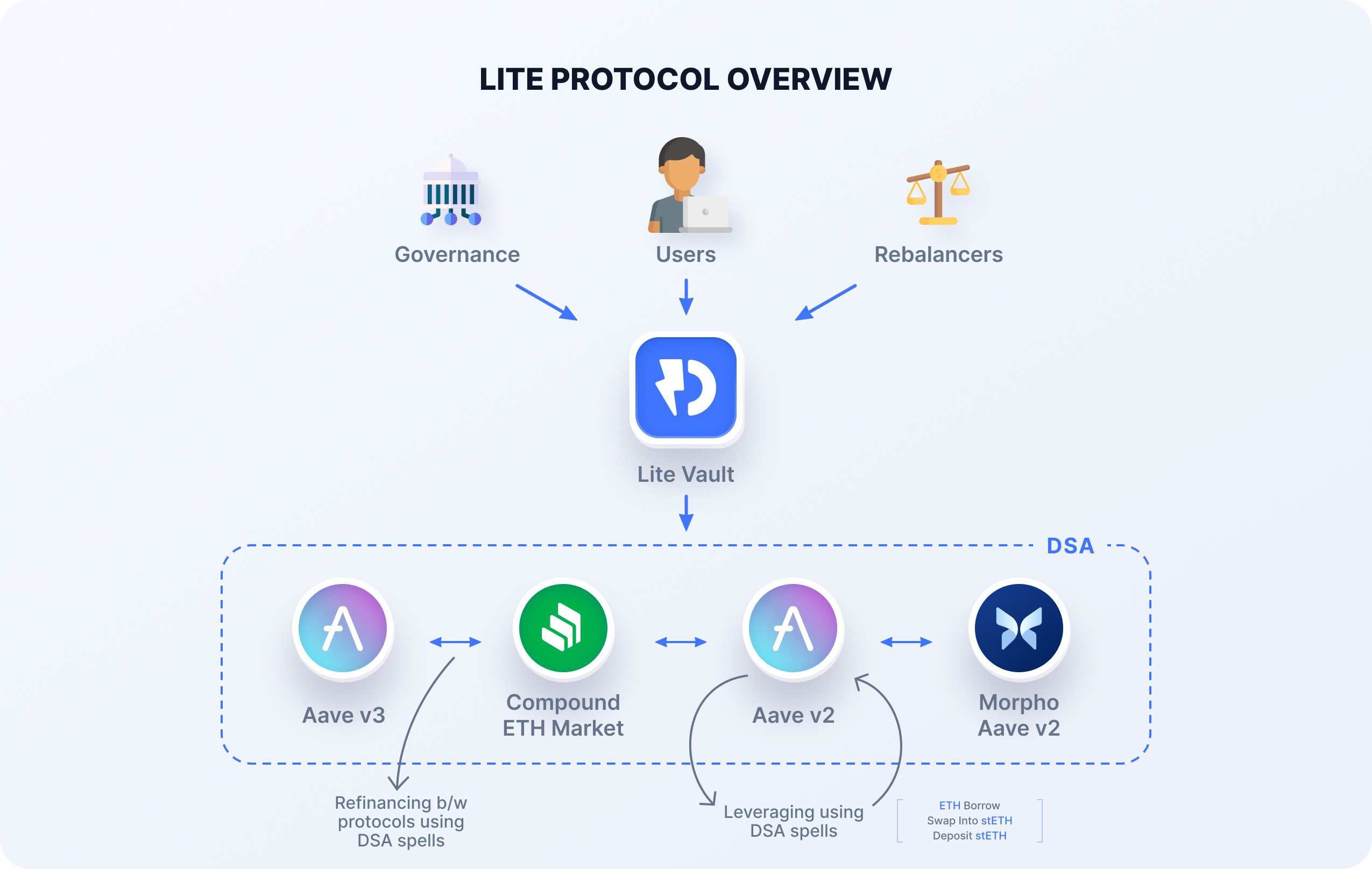
v2 & v3 Vaults can execute leverage strategies across multiple protocols. Lite Vaults deliver the most competitive rates by using multiple protocols.
*Vault supported protocols:* Compound, Aave V3, Spark, and Morpho.
{% hint style="info" %}
You can view which protocols are actively in use by the Lite vault in [Vault Analytics - Vault TVL by Protocol](https://dune.com/queries/2352792/3853881)
{% endhint %}
### Smooth Withdrawal Pool
The Lite Vault utilizes a leveraged strategy, which may limit liquidity availability. However, with enhanced withdrawals and multi-protocol support, funds can be efficiently rebalanced between protocols, leading to smoother withdrawals and higher withdrawal ratios.
## Vault Rebalancing
Fluid Lite Vaults will periodically rebalance either automatically or by an assigned role. Rebalancing can move funds to the withdraw pool, rebalance the vault or deleverage under unfavourable market conditions.
**Automatic Rebalancing**
Lite vaults use an automation server which can under certain circumstances rebalance or unwind the vault to prevent liquidations or to make more withdraws available. \
\
**Assigned Rebalancers**
Lite v2 introduces the 'Rebalancer' role, an on-chain account responsible for executing transactions within the vault. The Rebalancer can refinance and transfer funds between protocols, as well as leverage the vault, all within predefined parameters set by Governance. However, it is important to note that the Rebalancer does not have the ability to withdraw funds from the vault.
### Rebalancer Class System (Lite v3 – USD Vault)
To protect fLiteUSD deposits and the leveraged strategies that generate yield, Lite v3 introduces a **three-tier permission model**.
Each level controls which actions operators can perform on the vault and strategy infrastructure, limiting risk exposure while allowing routine maintenance and rebalancing.
#### Class 1 - Basic Operations
* Deploy idle USDC from the **fLiteUSD vault** into the default vault (**fUSDC**)
* Refinance positions between protocols
* Perform routine, low-risk operations
#### Class 2 - Standard Operations
Includes all **Class 1 permissions**, plus actions required to actively manage fLiteUSD strategies across protocols and chains:
* Withdraw USDC from the default **fUSDC** vault when capital is needed
* Allocate or remove capital from **strategy contracts**
* Bridge assets across supported chains (Ethereum, Arbitrum, Plasma)
* Trigger reconciliation to update the system’s total assets
#### Class 3 - Full Operations
Includes **Class 1 and Class 2 permissions**, plus high-privilege actions that directly modify leveraged positions used by fLiteUSD strategies.
* Open new leverage positions
* Close or deleverage existing positions
* Execute swaps required for strategy execution
* Update strategy parameters such as rate thresholds or risk limits
These operations directly impact the **leverage engine that drives fLiteUSD yield**, and therefore require the **strictest security controls and governance oversight**.
#### Security Model
{% hint style="info" %}
Each rebalancer class is assigned to separate authorized addresses (typically multisigs or automated bots). By splitting permissions across tiers, the system minimizes risk exposure - for example, a compromised Class 1 rebalancer cannot open leverage positions or withdraw capital.
{% endhint %}
### Learn More
#### Instadapp Blog: Launching Lite v2
{% embed url="" %}