> For the complete documentation index, see [llms.txt](https://lite.guides.instadapp.io/llms.txt). Markdown versions of documentation pages are available by appending `.md` to page URLs; this page is available as [Markdown](https://lite.guides.instadapp.io/getting-started/fluid-lite-usd-vault.md).
# Fluid Lite USD Vault
Enhancing Stablecoin Lending with Automated Leverage
**Fluid Lite USD is a yield-generating stablecoin vault that grows your balance over time.** Your funds are automatically deployed across optimized strategies so you can earn steady yield without actively managing positions.
No staking. No claiming. No position management.
Yield accrues through a rising exchange rate under the ERC-4626 standard. The vault automatically applies the higher of two rates - a fixed base rate (a guaranteed floor set by the protocol) or a reward-driven rate funded by a rewards pool. When TVL is lower, the reward rate is higher, benefiting early depositors. As more capital enters the vault, the reward rate gradually adjusts and converges toward the fixed base rate.
Deposit once. Earn automatically. Withdraw more.
### **USD Vault: Diversified Leveraged Stablecoin Yields**
The vaults accepts **USDC deposits** and issues **fLiteUSD** in return. These tokens are held in your wallet and increase in value over time as yield is generated.
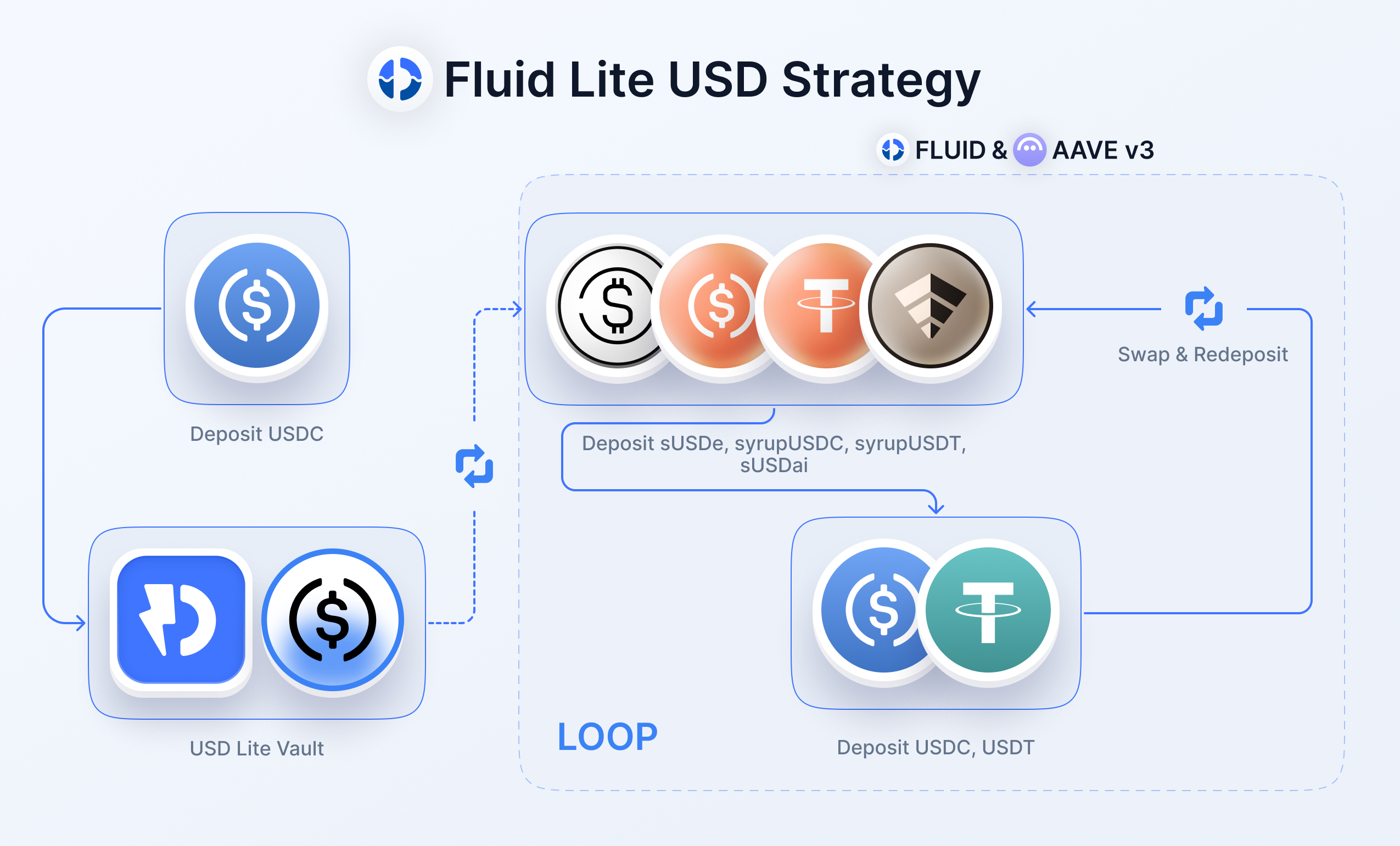
Deposits are then converted into an optimal mix of **yield bearing stablecoins** such as **sUSDe, syrupUSDC, syrupUSDT, and sUSDai**.
This vault automatically:
1. Deposit a yield-bearing stablecoin as collateral into a lending protocol
2. Borrow a stablecoin against that collateral
3. Swap the borrowed stablecoin back into more yield-bearing collateral
4. Repeat the loop to amplify the overall position
This structured looping increases exposure to lending yields in a capital-efficient way, while the vault automatically manages the process in the background.
A simplified overview of the Fluid Lite USD yield strategy.
### Built on Proven Infrastructure
Fluid Lite USD is built on **Fluid**, a battle-tested DeFi protocol - not from scratch. The vault follows the **ERC-4626 standard**, the most widely adopted tokenized vault standard in DeFi, allowing seamless integration with wallets, dashboards, and other protocols.
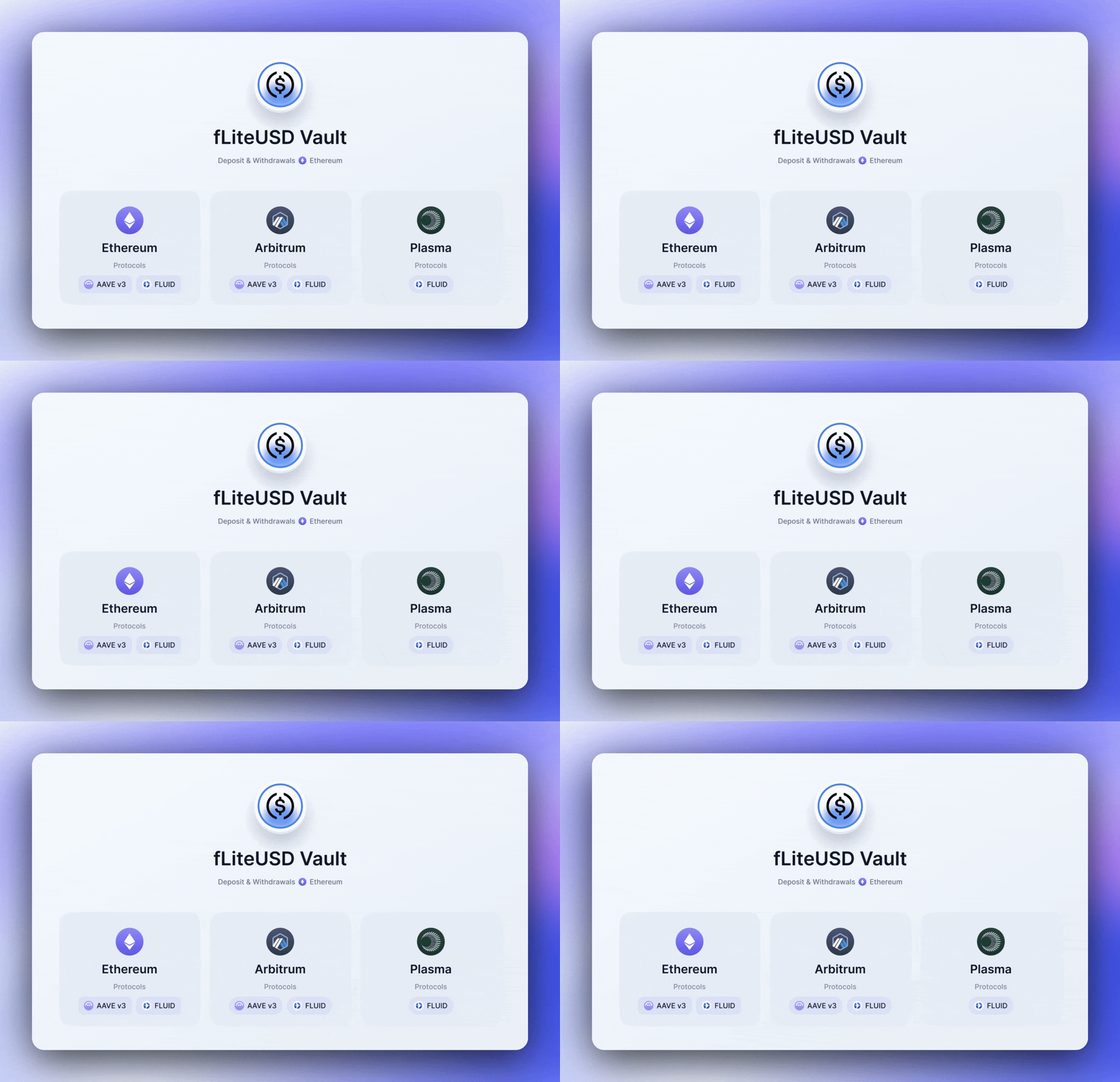
The underlying strategies are deployed across **three chains (Ethereum, Arbitrum, and Plasma)** and leverage **Aave and Fluid** - helping diversify risk while optimizing yield opportunities.
Additionally, a reserve mechanism is in place to help manage short-term fluctuations and maintain a consistent user experience.
### **Exchange Rate Mechanism**
The exchange rate between fLiteUSD and USDC is the core of the system. It determines how much USDC each fLiteUSD token is worth, and it only ever goes up. Here's how:
$$
ExchangeRate = lastCheckpointRate × (1 + max(fixedRate, rewardRate) × timeSinceCheckpoint)
$$
The **fixed rate** is a governance-set annual rate (e.g., 6%) that acts as a floor. The **reward rate** is derived from a reward pool divided by total vault shares.
The exchange rate updates via checkpoints triggered by any vault interaction, whether initiated by a user (deposit or withdraw) or by system-level configuration changes.
#### How Yield Accrues
* Yield in the USD Vault accrues continuously.
* The exchange rate of fLiteUSD updates on every interaction with the vault. Yield accrues continuously in the background, and it is applied to the exchange rate at the time of the next checkpoint (e.g., deposit, withdraw or configuration update).
* Weekly reconciliation does **not** control compounding. It is only used to rebalance strategies and aggregate cross-chain positions.
* Withdrawing mid-week does **not** forfeit earned yield. However, the vault charges a 5 bps (0.05%) withdrawal fee, so very short-term deposits may earn less than the withdrawal fee.
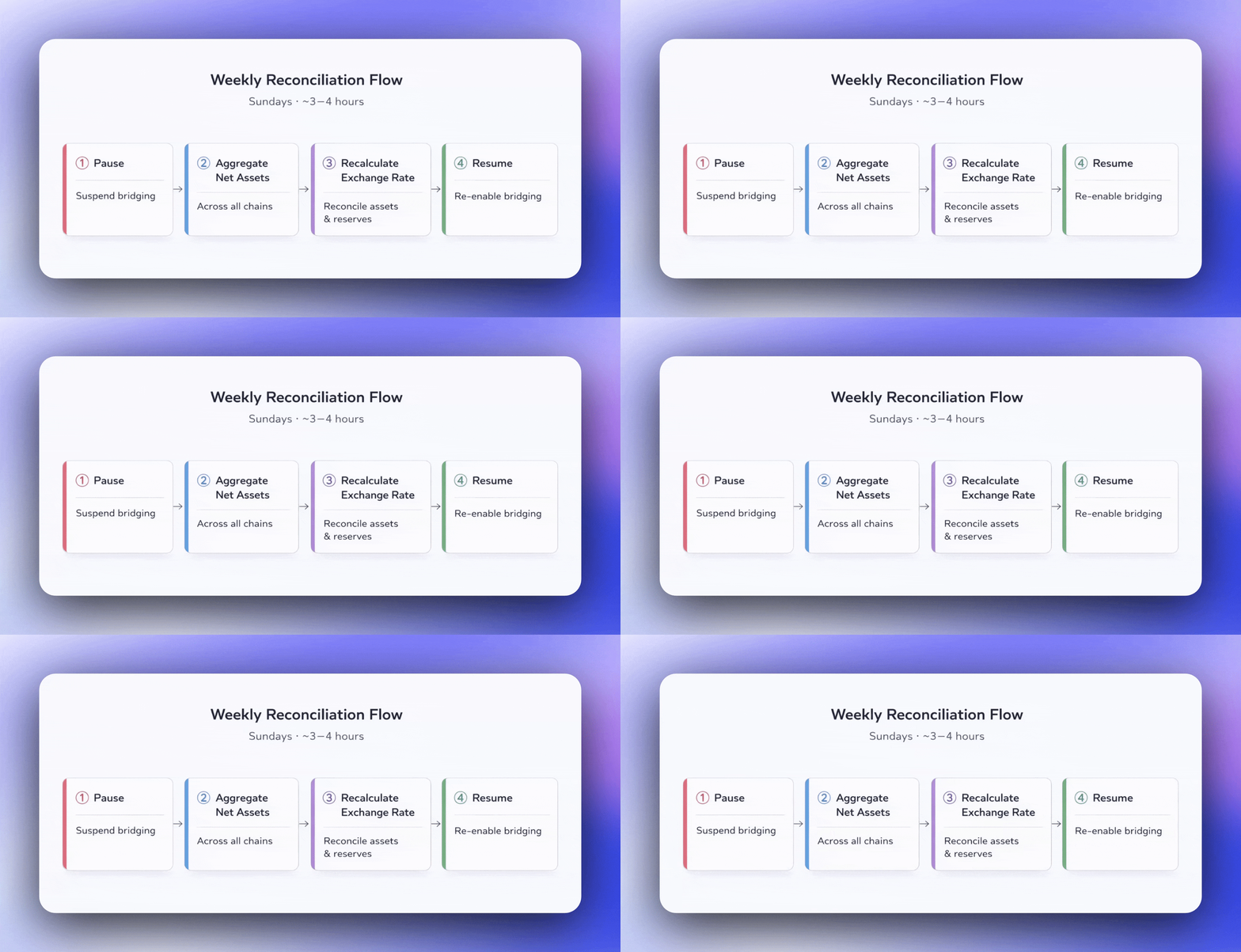
### Weekly Reconciliation
Each week (typically on Sundays), the system performs a reconciliation process. During this time, bridging is temporarily paused while the protocol aggregates net asset values across all chains and lending markets.
This ensures an accurate calculation of total assets, total liabilities, and the current reserve position.
{% hint style="info" %}
During the \~3–4 hour reconciliation window bridging is temporarily paused.
{% endhint %}
### Multi-Chain Architecture
While your USDC deposit happens on **Ethereum Mainnet**, the underlying strategies operate across **three chains**: Ethereum (Mainnet), Arbitrum and Plasma.
An overview of the multi-chain architecture behind fLiteUSD
Different tokens have native support on different bridges. Cross-chain capital movement uses **CCIP** (Chainlink) and **LayerZero OFT** bridges depending on the token. This is managed automatically - you never need to bridge anything yourself.
This movements are all managed automatically by the **Strategy Handler.**
### The Strategy Handler
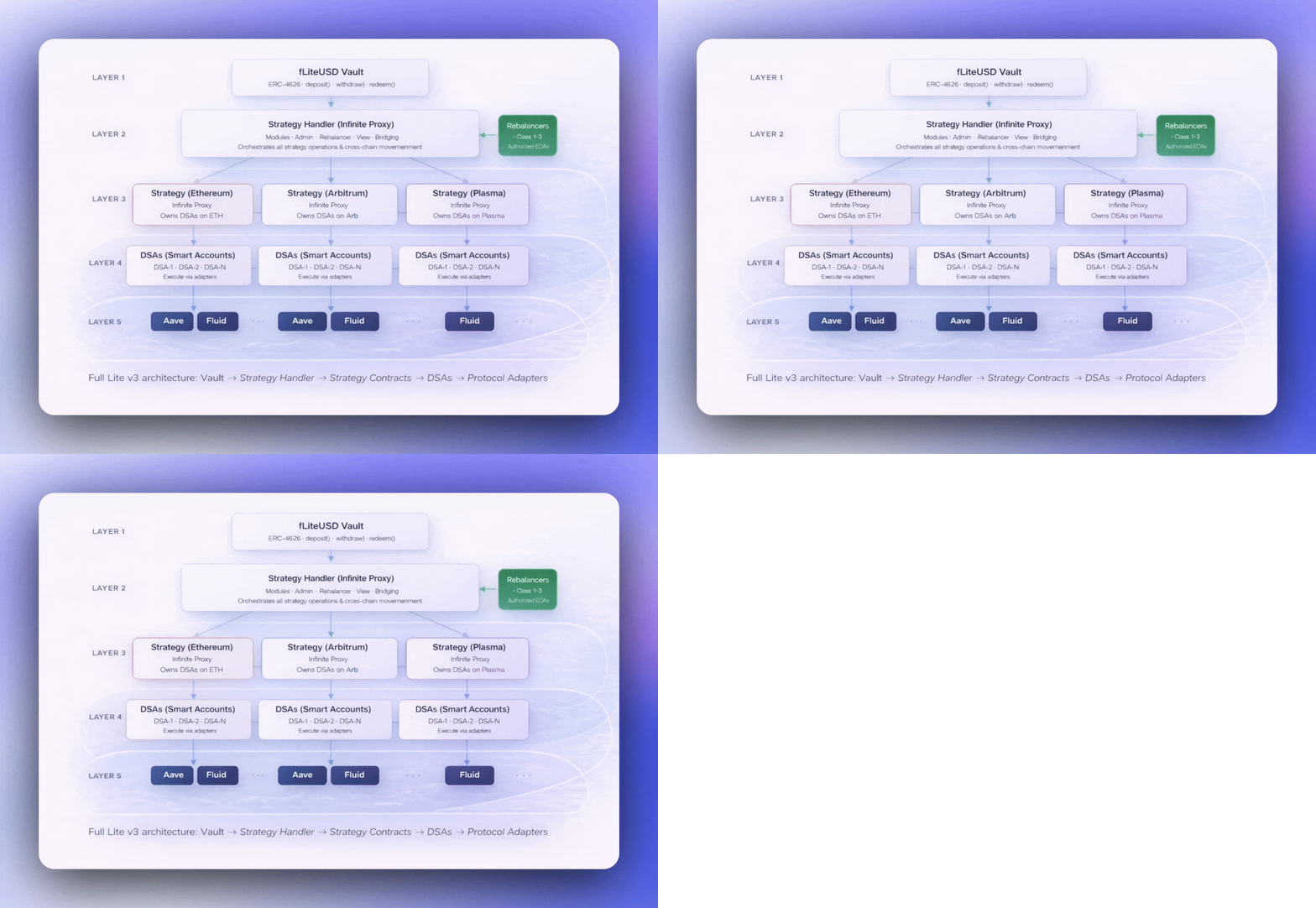
The **Strategy Handler** acts as the core coordinator of the USD Vault. It sits between the vault and the per-chain strategy contracts, managing capital allocation and execution logic.
It is built using the **Infinite Proxy pattern**, a modular architecture where functionality is separated into upgradeable modules:
* **Admin Module** — Governance controls such as adding or removing strategies and updating parameters
* **Rebalancer Module** — Executes capital movements, leverage adjustments, and token swaps
* **View Module** — Provides read-only data like net asset values and rate calculations
* **Bridging Module** — Handles cross-chain transfers and synchronization
Multi-Layer Yield Execution Framework
This modular design allows individual components to be upgraded independently while keeping the system flexible and secure.
### **Strategy Contracts & DSAs**
Each supported chain has a **Strategy Contract**, also built on the Infinite Proxy pattern. These contracts own and manage **DSAs.**
Each DSA represents a single position (e.g., "sUSDe/USDC on Fluid"). The strategy contracts can hold multiple DSAs, giving it the ability to run many parallel positions across different collateral/debt pairs and protocols on the same chain.
### Reserve System
The vault maintains reserves that act as a buffer to support a more stable and consistent experience over time.
If strategy returns temporarily fall below the base rate, reserves can help smooth the difference. When performance is stronger, excess yield contributes back to the reserves.
This mechanism is designed to reduce short-term fluctuations and improve overall predictability of returns.
### Putting It All Together :tada:
Here’s how your USDC deposit generates yield within the system:
* You deposit USDC into the **fLiteUSD vault**
* Idle USDC is deployed into Fluid’s USDC vault (**fUSDC**) as the base allocation
* Rebalancers distribute capital across chains using **CCIP and LayerZero bridges**
* On each chain, strategy contracts initiate leverage loops on **Aave** and **Fluid**
* Yield accumulates from the spread between collateral returns and borrowing costs
* Weekly reconciliation tallies everything up and **updates the exchange rate**
* When you withdraw, your **fLiteUSD** redeems for **more USDC** than originally deposited